
The most common question we get between June and August is simple. My air conditioning is blowing warm, what is this going to cost? The honest answer is that AC repair is not one price, it is a range that depends entirely on which part of the system failed. A quick recharge and a compressor replacement are separated by more than a thousand dollars, and the only way to know which one you are looking at is a proper diagnosis. Here is how the pricing actually breaks down in Boulder, what drives each number, and how to avoid paying for the same repair twice.
Typical Boulder AC repair price ranges
These are the ranges we see across the Front Range for common cars and SUVs. Your vehicle, refrigerant type, and parts availability move the number, and European models and hybrids usually land at the high end of each band.
- AC performance check and leak diagnosis: roughly $90 to $190. This is the step that tells you which repair you actually need.
- Evacuate and recharge with dye: roughly $180 to $350, higher on vehicles that use R-1234yf refrigerant, which most cars built after about 2015 do.
- Seal, O-ring, or service port repair: roughly $200 to $450 including the recharge.
- Condenser replacement: roughly $600 to $1,100. Front-mounted condensers take rock strikes on I-70 and US 36, so this one is more common here than in most of the country.
- Compressor replacement: roughly $1,100 to $2,200 with the receiver drier, expansion valve, system flush, and recharge that a correct compressor job requires.
- Evaporator replacement: roughly $1,300 to $2,500, because the dash usually has to come apart to reach it.
Why a recharge alone is usually the wrong answer
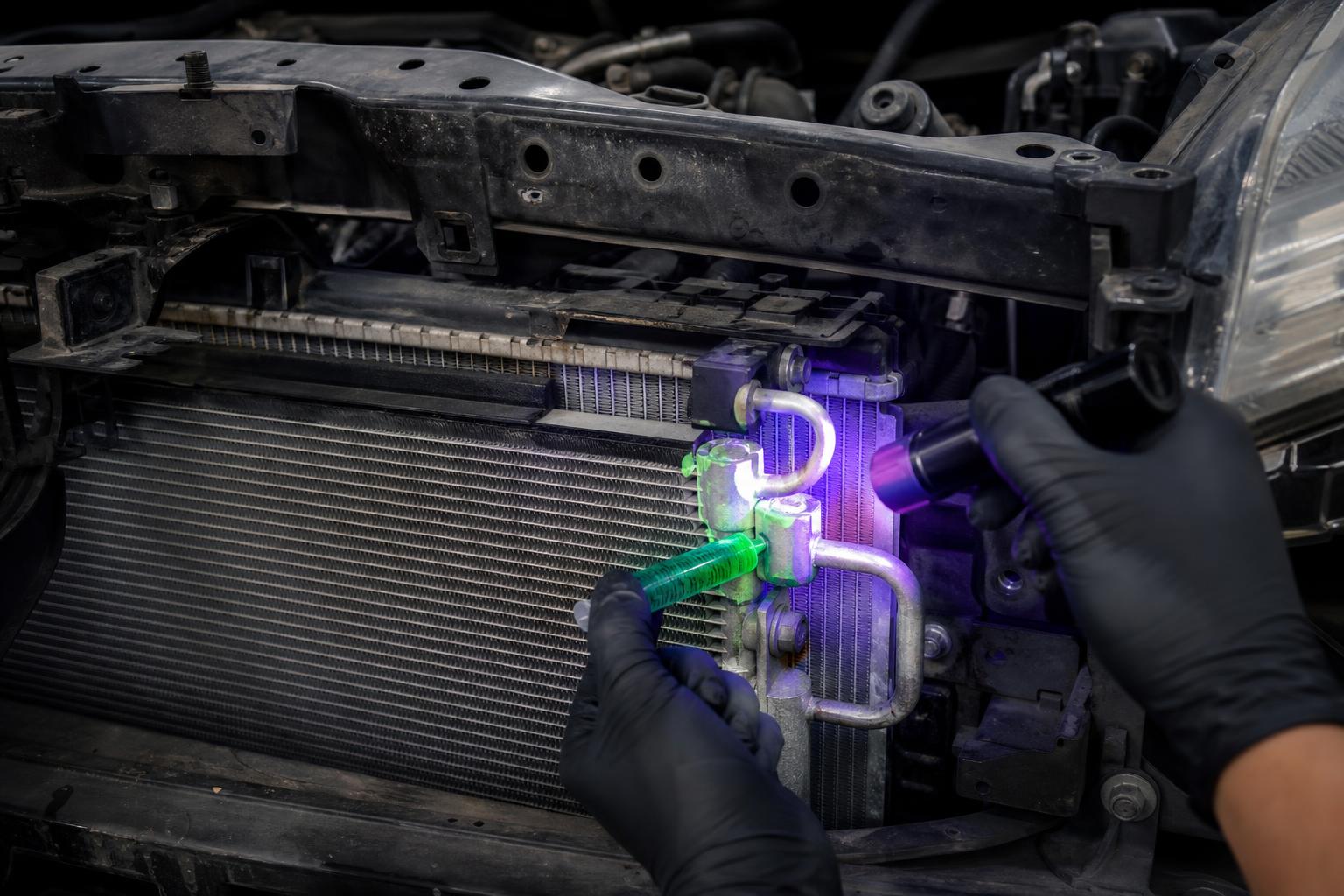
Air conditioning is a sealed system. It does not consume refrigerant the way an engine consumes oil. If your system is low, refrigerant left through a leak, and putting more in without finding that leak buys you a few weeks at best. That is the single most common way drivers end up paying twice in one summer. We inject dye, run the system, and use a UV light and an electronic sniffer to find the actual escape point before we quote a repair.
What Boulder adds to the bill
Altitude and sun are hard on air conditioning. Thinner air means the condenser has less mass to reject heat into, so a system that is merely weak at sea level is fully inadequate at 5,400 feet. Intense UV dries out rubber seals and hoses faster than in most climates, and big day-to-night temperature swings cycle those seals constantly. Gravel roads and highway rock strikes finish the job on condensers. That combination is why we tell customers to test the system in May, not on the first 95-degree day. The same logic applies to your cooling system, which shares the front of the car and the same air flow. Our cooling system prep guide walks through those checks.
The four questions that decide the price
- Which refrigerant does your car use? R-1234yf costs several times more per pound than the older R-134a, so the same recharge on a newer vehicle simply costs more.
- Where is the leak? An O-ring at an accessible fitting is an hour. An evaporator behind the dash is a day.
- Did the compressor come apart internally? A failed compressor sends metal debris through the whole system. A correct repair flushes the lines and replaces the drier and expansion valve. Skipping that saves money today and destroys the new compressor within a season.
- Is it actually the AC? A blend door actuator, a blower motor, a cabin filter packed with Boulder pollen, or a cooling fan that is not coming on can all feel like weak AC and cost far less to fix.
How to keep the number down
Run the AC for ten minutes every few weeks year round, including in winter. That keeps the seals lubricated and is the cheapest AC maintenance there is. Replace the cabin air filter on schedule, which matters more here than most places during pollen season in Boulder. Rinse the condenser fins when you wash the car. And get the system checked in the spring, before every shop in town has a three-week wait. Our pre-summer AC readiness guide covers what that check includes.
Getting an estimate you can trust
A real estimate names the failed part, the labor time, and the refrigerant charge separately. If a quote is a single lump number with no diagnosis behind it, ask what specifically failed and how they confirmed it. We put photos and measured readings in every estimate, and the work is covered by our nationwide NAPA warranty. For larger repairs like a compressor or evaporator, we also offer financing options so a surprise in July does not have to wait until fall.
When to come in now
- Vent air is cool but not cold, or cools only while moving
- You hear a squeal or clunk when the AC engages
- The system was recharged last summer and is warm again
- Oily residue near AC lines or the condenser
- Musty smell from the vents, which points to the evaporator area
Bring it in and we will tell you which of the ranges above you are actually in before any work starts. If you would rather start with the service details, our AC service and repair page lays out the full process.
Legacy Automotive Team
Boulder's NAPA Gold Certified shop since 2013. Real techs, honest writing, no AI fluff.


