Who Fixes Jeep Wrangler Death Wobble in Boulder?
Jeep Wrangler death wobble usually points to wear, looseness, or incorrect geometry in the front steering and suspension. Proper repair requires inspecting the whole system, especially the track bar and lift-related components.
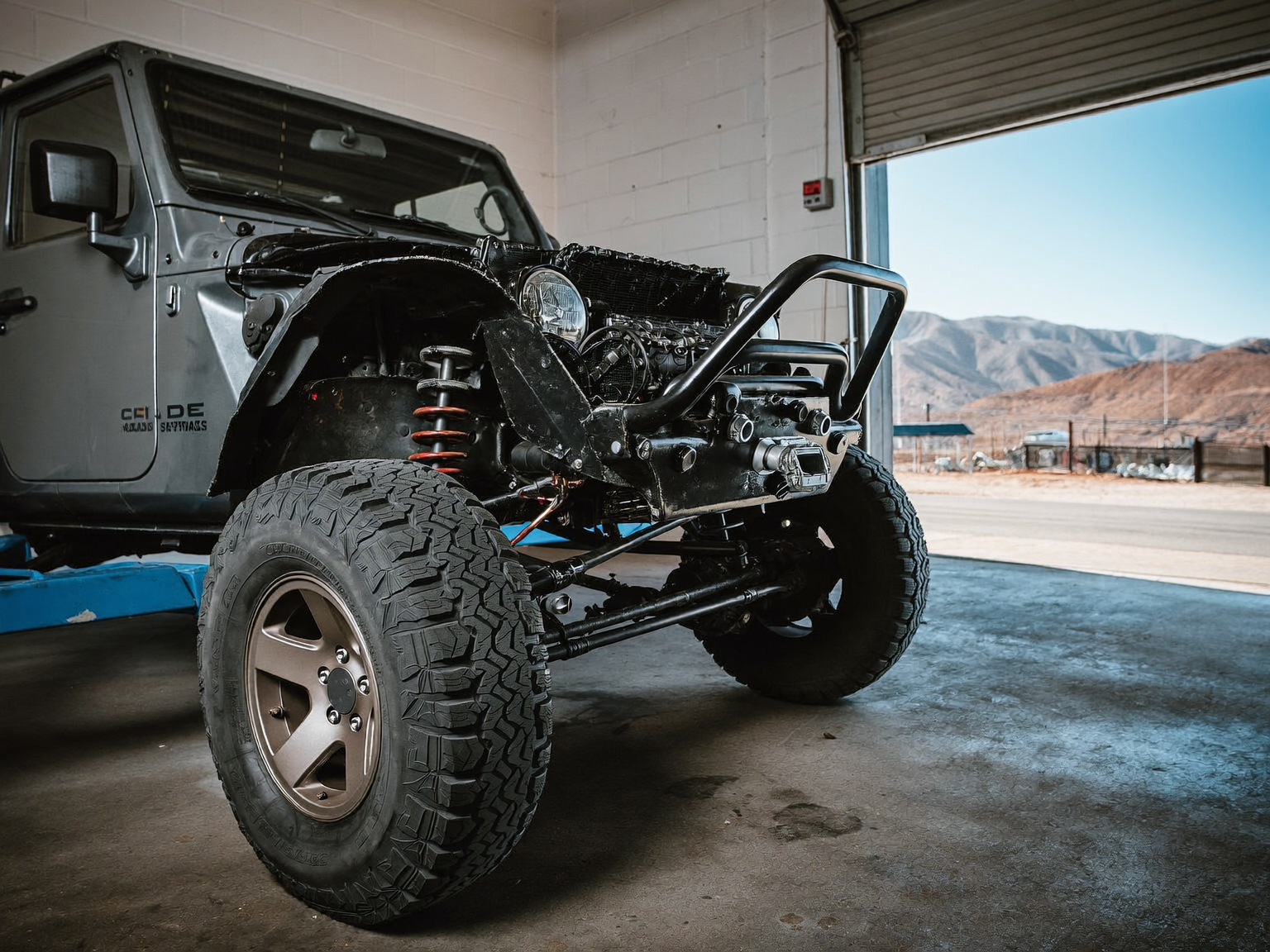
Jeep Wrangler death wobble is usually caused by looseness, wear, or incorrect geometry in the front steering and suspension, often involving the track bar, ball joints, tie rods, control arms, or lift-kit hardware. In Boulder, we diagnose and repair it by inspecting the complete front axle system rather than installing a steering stabilizer and assuming the problem is solved.
What Jeep Death Wobble Actually Feels Like
Death wobble is a rapid, violent side-to-side oscillation of the front axle and steering wheel. It commonly begins after a tire hits a pothole, bridge joint, expansion seam, or other sharp road irregularity at speed. The shaking may continue until the driver slows significantly.
That is different from a steady vibration caused by tire balance, a pull caused by alignment, or steering movement caused by strong Front Range crosswinds. We discuss those environmental effects separately in our guide to Colorado wind and your car. True death wobble feels as if the front wheels and axle are rapidly fighting each other.
Is death wobble a normal Jeep characteristic?
No, death wobble is not a normal trait that Wrangler owners simply have to accept. A solid front axle can transmit road forces differently than an independent front suspension, but a properly maintained Wrangler should remain controllable after crossing ordinary pavement joints and bumps. When an impact starts a violent oscillation, we look for mechanical play, loose fasteners, damaged mounting points, unsuitable alignment geometry, or several smaller problems acting together.
Which Steering and Suspension Parts Cause It?
A Wrangler’s front axle is located laterally by the track bar. Its steering system also relies on the drag link and tie rod, while the control arms position the axle beneath the vehicle. Ball joints allow the steering knuckles to move, and wheel bearings support the rotating wheel assemblies. Wear or movement anywhere in this connected system can contribute to instability.
For that reason, effective steering and suspension service must consider how the parts work together. Replacing the most visible worn component without checking the rest can leave the original trigger or underlying looseness in place.
Why is the track bar so important?
The track bar keeps the solid front axle centered under the Wrangler while allowing vertical suspension movement. If a track-bar joint is worn, a bolt is loose, a mounting hole has become elongated, or a bracket is cracked or shifting, the axle can move sideways in relation to the body. Because the steering linkage responds to that movement, even a small amount of play can become significant when a tire strikes a sharp bump. We inspect both ends of the bar, its bushings or joints, the bolt fit, the brackets, and the surrounding metal rather than checking only whether the bolts appear present.
What other worn components can contribute?
Ball joints, tie-rod ends, drag-link ends, control-arm bushings, wheel bearings, and steering gear mounting points can all contribute to death wobble. Worn shocks may reduce control after a bump, although shocks alone are not usually the complete explanation for a violent axle oscillation. We also inspect wheels, tires, axle components, and fastener condition because multiple modest sources of movement can combine into one severe symptom.
How Lift Kits Change Wrangler Steering Geometry
Lifted Wranglers require especially careful diagnosis. Raising the body and frame relative to the axles changes the operating angles of the track bar, drag link, control arms, driveshafts, and other components. The quality of the kit matters, but installation details, hardware condition, component compatibility, and final alignment matter just as much.
A Jeep may have driven acceptably after a lift was installed and developed wobble later as bushings settled, bolts loosened, tires wore, or an existing joint deteriorated. That timing does not automatically mean the entire lift is defective. It does mean the modified geometry must be included in the inspection.
Can an incorrectly installed lift kit cause death wobble?
Yes, a lift can contribute if the track bar and drag link no longer work through compatible arcs, the axle is not centered, caster is unsuitable, brackets flex, control-arm lengths are incorrect, or critical hardware was not tightened under the correct conditions. We also look for mixed components from different kits and improvised brackets that change mounting positions without adequately controlling the added leverage. Our Jeep service in Boulder accounts for both factory suspension designs and modified vehicles, including how aftermarket parts affect the original geometry.
Is a steering stabilizer the real fix?
Usually not by itself. A steering stabilizer can damp normal feedback and help control sudden steering inputs, but it should not be used to hide loose track-bar hardware, worn joints, damaged brackets, or incorrect alignment angles. A stronger stabilizer may temporarily reduce the symptom while the underlying movement remains. If a stabilizer is leaking, bent, seized, or worn, it should be addressed, but only after the rest of the system has been evaluated.
How We Diagnose Death Wobble
We begin by asking when the wobble occurs, what speed and road condition trigger it, whether the Jeep is lifted, and what steering or suspension work was performed recently. Those details help distinguish death wobble from tire vibration, brake pulsation, driveline vibration, and engine hesitation.
A complaint that occurs after a pavement impact points us toward the front suspension and steering. Bucking that appears mainly during acceleration may lead somewhere else entirely. Fuel contamination and drivability issues, for example, are separate from the steering oscillation discussed here, as explained in our article about bad gas in Colorado.
How are loose steering parts found?
We inspect the system while the joints are loaded and moved through the forces they experience on the road. One technician may move the steering while another watches and feels the track-bar ends, steering linkage, ball joints, brackets, and steering gear attachment points. We check for movement between a bolt and its mounting hole, not only movement inside a joint. We also examine witness marks, rust trails, polished metal, cracked coatings, distorted brackets, and other evidence that parts have shifted under load.
Could the wheels and tires be the trigger?
Yes, tire and wheel conditions can initiate or intensify the oscillation even when they are not the only mechanical fault. Irregular tread wear, separated internal tire construction, incorrect pressure, excessive wheel imbalance, bent wheels, and heavy aftermarket wheel-and-tire combinations can place additional force into worn steering parts. Tire condition must therefore be evaluated alongside the track bar, linkage, bearings, and suspension geometry rather than treated as an unrelated check.
Does a wheel alignment cure death wobble?
An alignment may be part of the correction, but it cannot tighten a loose bolt, restore a worn ball joint, or repair a damaged track-bar bracket. Measurements such as caster and toe help us understand how the Wrangler will track and how readily its wheels return toward center. On a lifted Jeep, alignment readings also reveal whether the suspension modifications provide enough adjustment to restore suitable geometry. Mechanical wear and looseness must be repaired before final alignment measurements can be trusted.
What Should You Do If It Happens on the Road?
Death wobble is alarming, but abrupt steering or braking can make an already unstable situation harder to manage. Keep both hands on the wheel, remain as smooth as conditions allow, ease off the accelerator, and move toward a safe stopping location once the oscillation subsides. Activate the hazard lights when appropriate and avoid continuing at the speed that triggered the event.
Is it safe to keep driving after the shaking stops?
We do not recommend treating the disappearance of the shaking as proof that the Jeep repaired itself. The event may stop when vehicle speed drops, but the worn joint, loose fastener, damaged bracket, or geometry problem remains. Another pothole or pavement seam can trigger it again. If steering feels loose, parts are visibly displaced, or the wobble was severe, arrange safe transport rather than attempting another high-speed drive.
Serving Jeep Drivers Across Boulder and the Front Range
Boulder roads provide plenty of potential triggers for a vulnerable front end. Pavement transitions on US-36, rough patches along major cross-town routes, freeze-thaw damage, and broken surfaces near foothills roads can send a sharp impact through a Wrangler’s solid axle. Canyon approaches add curves and elevation changes where predictable steering is particularly important.
We provide Jeep death wobble repair in Boulder for drivers from Table Mesa and South Boulder, Gunbarrel and northeast Boulder, and surrounding communities such as Louisville. We also see Jeeps that commute along US-36, travel toward Lafayette and Superior, or spend weekends on washboard roads and foothills terrain.
Why does local driving context matter during diagnosis?
A Wrangler used mainly for Boulder commuting experiences different loads from one carrying recovery equipment, larger tires, armor, or camping gear into the foothills. Snow, deicing residue, washboard surfaces, trail impacts, and repeated pothole strikes can expose looseness that is less obvious during a brief low-speed drive. When performing auto repair in Boulder, we ask how the Jeep is actually used so we can evaluate the hardware, geometry, and tire setup under the right assumptions.
Repair the System, Not Just the Symptom
A sound death wobble repair begins with identifying every meaningful source of movement. Depending on the findings, that may involve track-bar joints or hardware, bracket repair, steering linkage, ball joints, control-arm components, wheel bearings, tires, alignment correction, or lift-kit changes. The exact repair should follow evidence from the inspection, not a standard list of parts installed on every Wrangler.
As a Boulder mechanic familiar with stock and modified Jeeps, we also verify the completed repair as a system. Fastener fit and torque, axle position, steering geometry, wheel and tire condition, and road behavior all matter. That complete approach is how we restore stable steering without asking a new stabilizer to conceal an unresolved mechanical problem.
Book the shop Boulder trusts.
Free loaner vehicles for qualifying repairs. Three-year, 36,000-mile NAPA warranty on every covered job.